News
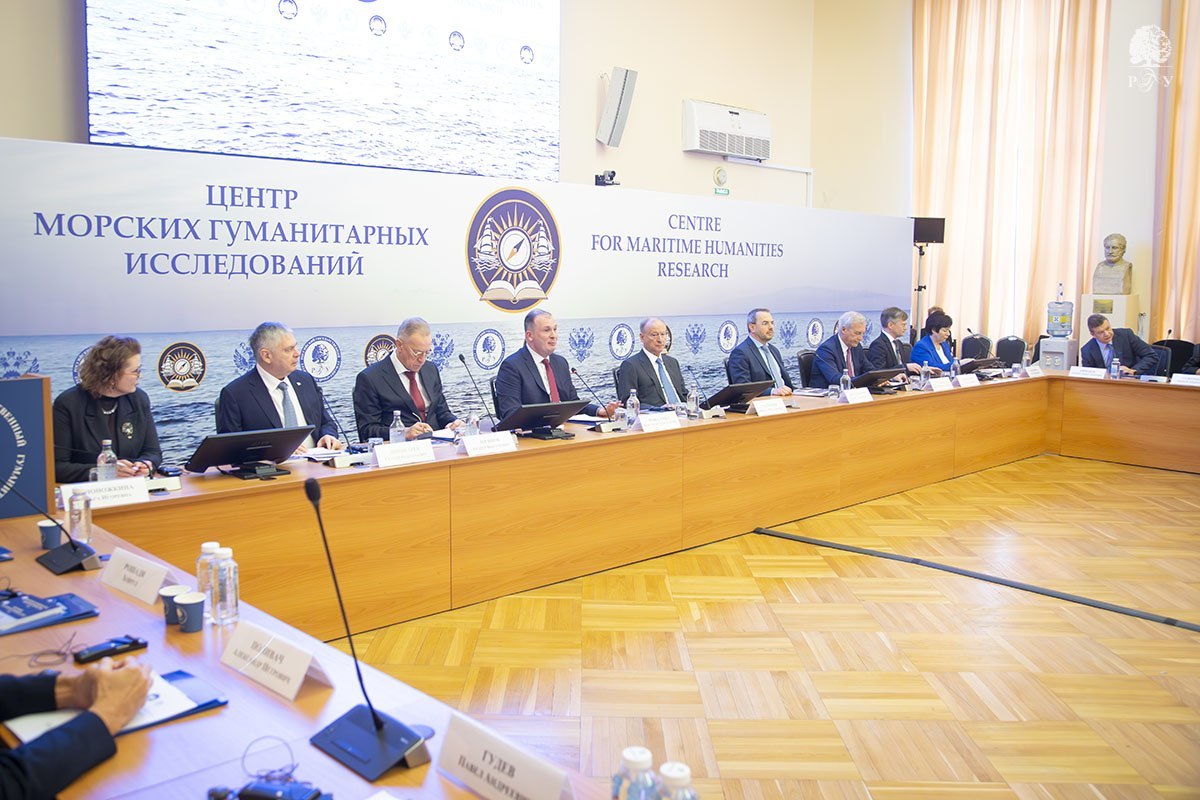 On September 18, the Center for Maritime Humanities Research, established by decision of the President of Russia, opened at the Russian State University for the Humanities (RSUH).
The ceremony was attended by Nikolai Patrushev, Assistant to the President of the Russian Federation and Chairman of the Maritime Collegium of Russia; Konstantin Mogilevsky, Deputy Minister of Science and Higher Education of the Russian Federation; Alexander Grushko, Deputy Minister of Foreign Affairs of the Russian Federation; Andrey Loginov, RSUH Rector; and Sergey Shishkarev, Chairman of the Board of Directors of the Delo Group of Companies and Member of the Maritime Collegium.
In his welcoming speech, Sergei Shishkarev noted that the Centre’s work would make it possible to supplement humanitarian and historical research with expertise on current issues in the maritime industry and to make a practical contribution to the activities of the Russian Maritime Collegium.
After the solemn ceremony, the work continued within the framework of the international strategic session “The Impact of Maritime Power on the World Order: Lessons from History and the Present.” Russian and foreign experts discussed the impact of maritime power on the modern world order, the international legal aspects of the use of maritime spaces, and Russia’s historical heritage in the World Ocean.
Sergey Shishkarev drew attention to the current challenges facing maritime transport and logistics, emphasizing that geopolitical changes, sanctions restrictions, and increased control over shipping directly affect routes and transportation costs. “Today, 80% of global trade by volume is accounted for by maritime transport. That is why any international political shifts almost instantly turn into risks for shipping,” Sergey Shishkarev noted.
The Chairman of the Board of Directors of the Delo Group of Companies proposed a set of measures to adapt Russian logistics to external challenges. Among them are the development of the country’s own merchant fleet and sovereign logistics infrastructure outside the Russian Federation, as well as the expansion of state support in the form of preferential loans to banks that support transactions involving the acquisition of merchant ships, including those flying foreign flags.
In addition, the discussion focused on developing transport routes bypassing unfriendly countries, including the Arctic corridor and the North‑South corridor, creating mechanisms to cover military risks, simplifying settlements with BRICS countries and other friendly states, as well as introducing additional measures to protect ships and preparing crews for actions in crisis situations.
The photo is provided by RSUH.