News
 International Joint‑Stock Company “Global Ports Investments” (‘Global Ports’ or the ‘Company’, together with its subsidiaries and joint ventures – the ‘Holding’, part of the Delo Group) today announces its operational results for Q2 and H1 2026.
Russian marine container market
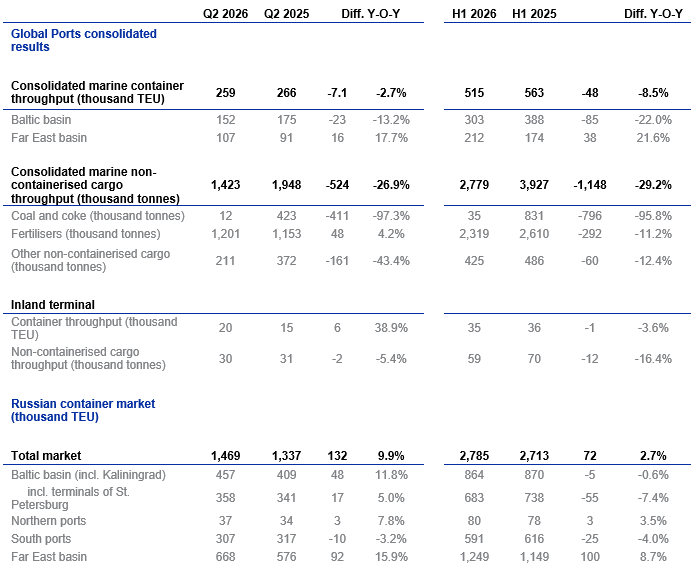
In Q2 2026, the Russian marine container market grew by 9.9% y‑o‑y, driven by a partial recovery of containerised imports and a carry‑over of volumes from Q1 2026, which had been under pressure from global supply chain disruptions and severe ice conditions in the Baltic basin. In H1 2026, the Russian market increased by 2.7% y‑o‑y to 2,785 thousand TEU.
Dynamics across basins remained uneven as a result of global logistics chain instability: demand for handling at Far Eastern basin terminals strengthened noticeably due to a shift in demand away from Baltic and Black Sea ports. Baltic basin terminals, which experienced severe ice conditions during the first two months of the year, increased container throughput by 11.8% y‑o‑y in Q2, while overall H1 throughput declined by 0.6% y‑o‑y to 864 thousand TEU. Container throughput in the Far East basin accelerated in Q2 to 15.9% y‑o‑y, bringing H1 growth to 8.7% y‑o‑y, with throughput reaching 1,249 thousand TEU.
Global Ports consolidated performance
In Q2 2026, the Holding’s consolidated marine container throughput decreased by 2.7% y‑o‑y to 259 thousand TEU, and in H1 2026 by 8.5% y‑o‑y to 515 thousand TEU. At the same time, the Far East terminal significantly outperformed the regional market in both the reported quarter and H1, recording a 17.7% y‑o‑y increase in container throughput in Q2 2026 to 107 thousand TEU and a 21.6% y‑o‑y increase in H1 to 212 thousand TEU. In the Baltic basin, amid severe ice conditions in the early months and the resulting temporary shift of cargo to other basins and transport modes, the Holding’s container throughput decreased by 13.2% y‑o‑y in Q2 and by 22.0% y‑o‑y in H1 2026.
Non‑containerised cargo
As the Holding continues to transition away from coal handling in favour of higher‑margin cargo types (notably fertilisers), consolidated non‑containerised cargo throughput declined by 26.9% y‑o‑y in Q2 and by 29.2% y‑o‑y in H1 2026, reaching 2.8 million tonnes for the half‑year. Fertiliser handling in the Baltic basin was also under pressure in H1 due to unfavourable ice conditions, falling by 11.2% y‑o‑y, although a recovery was seen in Q2 2026 with a 4.2% y‑o‑y increase.
Outlook
Against the backdrop of persistent instability in global maritime and local logistics chains, management expects strong demand for container throughput in the Far East and moderate demand in the Northwest to persist in the coming months, with demand focused on terminals that have well‑developed rail infrastructure.
Key operational information:
Rounding adjustments have been made to calculate some of the operational information included in this release. As a result, numerical figures and percentages shown as totals in some tables may not be exact arithmetic aggregations. Market data throughout this release are based on information from the Association of Sea Trade Ports (ASOP).